Butterfly · OFF
Hadraw SK
7W · All wood
Specifications
- Playing style
- OFF
- Price
- Not published
- Weight
- 85 g
- Thickness
- 6.4 mm
- Plies
- 7
- Composition
- 7W · All wood
- Outer ply
- Limba
- Core wood
- Ayous
- Carbon type
- Not published
- Fibre placement
- None
- Blade size
- 157 × 150 mm
- Handle types
- FL · AN · ST
- Made in
- Not published
- Release year
- Not published
Metadata confidence: Secondary sources
Blade construction
Estimated7W · All wood
7 plies · Limba surface · all-wood · Ayous core · 6.4 mm total
One blade, drawn as technical linework at real shakehand proportions. The laminated edge along the crown and right rim exposes every ply boundary in the stack. Edge depth is illustrative because physical veneer thickness is not published.
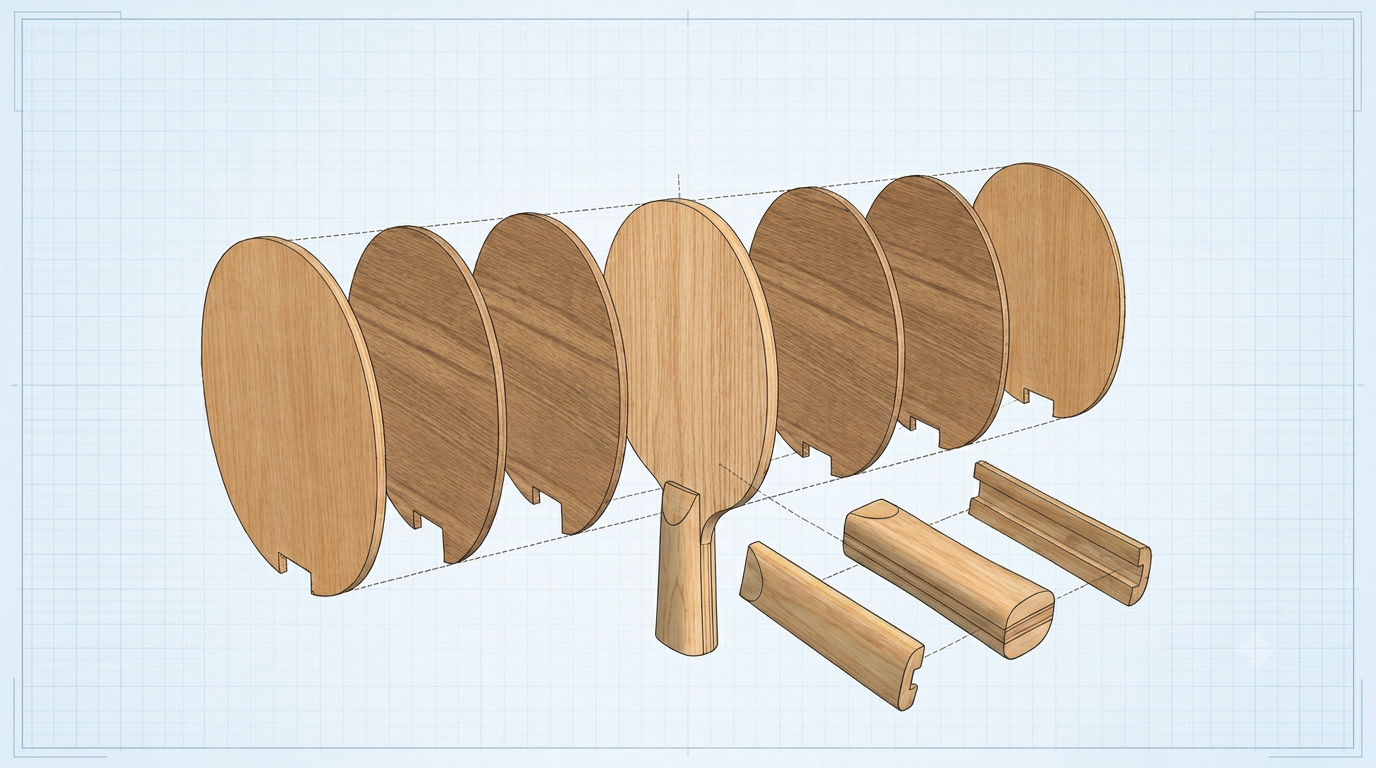
Stack order · outer face to outer face
1 · Outer ply
Limba
2 · Medial ply
Ayous
3 · Medial ply
Ayous
4 · Core
Ayous
5 · Medial ply
Ayous
6 · Medial ply
Ayous
7 · Outer ply
Limba
Limba
Outer ply · layers 1 and 7
Softer touch · Longer dwell
Ayous
Medial ply · Core · layers 2, 3, 4, 5 and 6
Lower weight · Wider sweet spot
Stack order — face A to face B
- 01LimbaOuter ply
Soft, open-grained outer veneer — long dwell, a wooden feel and easy spin on slow strokes.
- 02AyousMedial ply
Very light medial or core wood — keeps the blade low in weight and widens the sweet spot.
- 03AyousMedial ply
Very light medial or core wood — keeps the blade low in weight and widens the sweet spot.
- 04Ayous — coreCore
Very light medial or core wood — keeps the blade low in weight and widens the sweet spot.
- 05AyousMedial ply
Very light medial or core wood — keeps the blade low in weight and widens the sweet spot.
- 06AyousMedial ply
Very light medial or core wood — keeps the blade low in weight and widens the sweet spot.
- 07LimbaOuter ply
Soft, open-grained outer veneer — long dwell, a wooden feel and easy spin on slow strokes.
Secondary sources · 7 of 7 plies with published material · stack order unconfirmed
About this blade
Butterfly Hadraw SK is a 7-ply blade built around an all-wood stack, with Limba on the playing surface and a Ayous core. Limba in the outer layer: Soft, open-grained outer veneer — long dwell, a wooden feel and easy spin on slow strokes. Ayous in the medial layer: Very light medial or core wood — keeps the blade low in weight and widens the sweet spot. Ayous in the core: Very light medial or core wood — keeps the blade low in weight and widens the sweet spot. Physically it measures 6.4 mm thick, around 85 g. Butterfly positions it for off play.
TTDNA ratings
NormalizedPerformance
Construction
Material properties
Playing profile
A TTDNA blade rating measures how much of the named characteristic a blade has. For descriptive rows — flex, stiffness, vibration, head heaviness, weight, thickness, carbon feel, softness, technique requirement, spin sensitivity — a higher number means more, not better.
TTDNA ratings are normalized comparison values, not laboratory measurements. They are built from published specifications, technical sources and structured product evidence, converted to one 0–100 scale. Where a directly comparable measurement is unavailable, the value is an evidence-based estimate. Overall-style scores are composites of several characteristics. Methodology